
Water Activity: Post-Harvest Microclimate Control Guide
Water Activity: 7 Proven Tips for Better Curing
Meta description: Water activity guide for humidity control, temperature control, drying cabinets, curing, storage, and better post-harvest consistency.
Key Takeaways
- Water activity measures how much available water remains inside a material, not just how dry it feels on the surface.
- Post-harvest quality usually depends on stable temperature, humidity, airflow, and storage conditions.
- A drying and curing machine can help small-batch growers reduce a lot of room-drying guesswork.
- A temperature controller and humidity controller tend to work best together, creating a more stable microclimate.
- The goal is not only faster drying. In most cases, the real goal is better aroma, texture, storage confidence, and batch consistency.
What Is Water Activity?
Water activity is a measurement of how much available water remains inside a material.
It is different from moisture content, and that difference trips up a lot of people.
Moisture content tells you the total amount of water. Water activity tells you how active that remaining water actually is.
That matters because available water can affect microbial growth, texture, aroma stability, and storage quality.
The FDA water activity guidance explains that aw is based on the vapor pressure of a product compared with pure water under the same conditions.
For growers, the simple meaning is this:
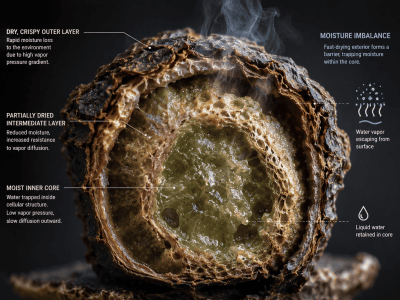
A batch can feel dry on the outside but still be unstable inside.
That is why this metric is so useful during drying, curing, and storage.

Why Is Water Activity Important After Harvest?
Post-harvest quality does not end when the plant is cut. If anything, that is where a lot of the work really starts.
Drying and curing still affect:
- aroma
- flavor
- smoothness
- texture
- storage life
- microbial risk
- batch consistency
Many growers spend months managing cultivation, but one poor drying cycle can quietly reduce the final result.
The problem is usually not one single mistake.
It is more often a mix of unstable temperature, unstable humidity, uneven airflow, and poor timing.
A room may feel fine when you walk in. But over 24 hours, that same room can shift many times without you noticing.
Air conditioning may lower humidity. A heater may dry the air too fast. Rainy weather may slow drying down. A fan may hit one side harder than another.
This is why FlavorWise microclimate control focuses on drying, curing, and storage in a controlled environment.
The goal is to manage moisture movement slowly, evenly, and repeatedly.
Water Activity vs Moisture Content
Moisture content and water activity are related, but they are not the same thing.
The USDA water activity explanation says aw is connected to equilibrium relative humidity. For example, an aw value of 0.70 equals about 70% equilibrium relative humidity in a sealed container at constant temperature.
| Factor | Moisture Content | Water Activity |
|---|---|---|
| Measures | Total water amount | Available water |
| Common unit | Percentage | aw scale from 0 to 1 |
| Best use | Tracking drying progress | Judging stability risk |
| Main weakness | Can miss hidden instability | Requires a meter |
| Practical value | Shows how much water remains | Shows how risky that water may be |
Touch helps.
Smell helps.
Weight loss helps.
But from experience, a measured aw value gives you much stronger information before curing or storage.
What Range Should Growers Understand?
There is no single perfect number for every plant material, and anyone who promises one is oversimplifying.
But general science still gives useful risk zones.
AQUALAB water activity guidance explains that most bacteria do not grow below about 0.91 aw, and most molds stop growing below about 0.70 aw.
| aw Range | Practical Meaning |
|---|---|
| 0.95+ | High microbial growth potential |
| Around 0.85 | Important shelf-stability threshold in food safety |
| Around 0.70 | Mold risk becomes much lower for many materials |
| Below 0.60 | General point where microbial growth is strongly limited |
Important: These are general safety and stability concepts, not a universal flower or botanical specification.
For commercial production, final targets should really be validated by product type, lab testing, local rules, and storage goals.
For small-batch growers, the lesson is simple:
Do not judge the batch by time only.
How Water Activity Affects Humidity Control
Humidity control is one of the most important parts of post-harvest work, and probably the one people underestimate the most.
If humidity is too low, moisture can leave the outside too quickly.
That can make the surface feel finished while the inside still needs time to balance.
If humidity is too high, the drying process can slow down too much.
That may increase unwanted risk and make curing less predictable.
A humidity controller helps reduce these swings.
Instead of letting the room decide the process, the grower can keep the cabinet environment closer to a target range.
This is especially useful for home growers and small-batch growers.
Small rooms, tents, closets, and garages usually do not stay stable all day, no matter how careful you are.
Why a Temperature Controller Also Matters
Temperature affects how water moves.
It also affects aroma and chemical stability.
Higher heat can speed up drying, but faster is not always better. In fact, it is often worse.
A post-harvest drying review of a specific flower crop explains that drying, storage, and curing are major post-harvest operations, and poor drying can create inconsistent quality.
A temperature controller helps keep the process steady.
That does not mean the grower needs a full laboratory setup.
It just means the environment should not swing wildly from hour to hour.
Stable temperature supports stable drying.
Stable drying supports better curing.
Better curing supports better storage.
Why Room Drying Often Creates Inconsistent Results
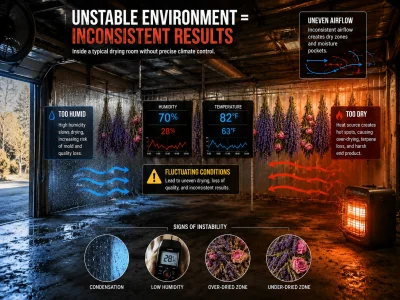
Room drying can work, but it is hard to repeat reliably.
The room is affected by too many outside factors at once.
Common problems include:
- HVAC cycles
- outside weather
- door openings
- sunlight
- fan placement
- uneven hanging
- overloaded drying space
- changing day and night conditions
This creates a process that tends to change every day.
One batch may dry perfectly.
Another batch may finish too fast.
Another may need extra curing time.
Another may smell weaker than expected.
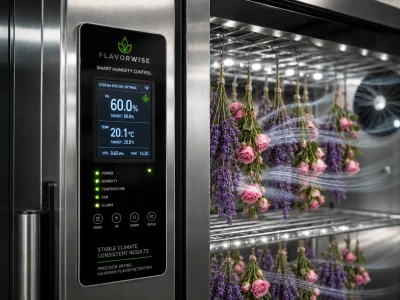
A dedicated drying cabinet reduces the size of the environment.
And in most cases, a smaller controlled space is much easier to manage than an entire room.
You can also read FlavorWise’s related article on who the FlavorWise curing chamber is for.
Dry Cabinet vs Drying Cabinet vs Humidity Chamber
These terms sound similar, but the purpose behind each one is different.
| Term | Main Purpose | Best Use |
|---|---|---|
| Dry cabinet | Stable low-humidity storage | Protecting sensitive materials from moisture |
| Drying cabinet | Controlled moisture removal | Post-harvest drying |
| Humidity chamber | Controlled humidity environment | Testing, conditioning, curing, or stability work |
| Drying and curing machine | Full post-harvest workflow | Drying, curing, and storage support |
A dry cabinet is usually more storage-focused.
A drying cabinet is used to remove moisture in a controlled way.
A humidity chamber is used when the main goal is controlled humidity testing or conditioning.
A drying and curing machine is more workflow-focused.
It supports the process from drying all the way into curing and storage.
How a Drying and Curing Machine Helps Small-Batch Growers
A drying and curing machine helps create a dedicated microclimate around the batch.
That means the grower is not relying only on whatever the room happens to be doing.
FlavorWise is built for home and small-batch growers, with support for 3–6 plants per batch and 5–10 lbs of fresh material per batch.
The machine can help manage:
- temperature
- humidity
- airflow
- drying speed
- curing stability
- storage environment
This matters because small-batch growers usually want consistency above almost everything else.
They do not want one harvest to smell great and the next harvest to feel flat.
They want a repeatable process.
Repeatability is the real value of controlled post-harvest equipment.
For more product details, visit the FlavorWise post-harvest processing product page.

7 Proven Tips for Better Post-Harvest Control
1. Start with consistent batch size.
Do not overload the cabinet.
If one batch is much larger or denser than another, drying behavior will change, sometimes more than you expect.
Leave enough space for airflow.
2. Avoid aggressive airflow.
Strong direct wind can dry the surface too fast.
Gentle and even airflow is usually better for balanced drying.
The goal is not to blast moisture out.
The goal is to move moisture out evenly.
3. Keep temperature stable.
Large temperature swings make the whole process harder to control.
Use a temperature controller or controlled cabinet environment where possible.
4. Keep humidity stable.
Humidity control helps prevent the batch from drying too fast or too slowly.
Avoid sudden crashes in relative humidity.
5. Track weight loss.
Weight gives a simple, honest signal of drying progress.
It does not replace testing, but it does help show how the batch is changing over time.
6. Measure when possible.
A meter can help confirm stability more accurately than touch alone.
This is especially helpful before long-term storage.
7. Record every batch.
Write down the batch size, drying time, temperature range, humidity range, final texture, aroma, and storage result.
Over time, this creates your own repeatable post-harvest standard.
Simple Batch Tracking Template
| Data Point | What to Record |
|---|---|
| Harvest date | When drying started |
| Batch size | Fresh weight or estimated load |
| Setup | Hanging, tray, trim style |
| Temperature range | Daily high and low |
| Humidity range | Daily high and low |
| Airflow | Gentle, strong, uneven, adjusted |
| Drying time | Total days or hours |
| Measured value | aw reading if available |
| Texture | Too wet, balanced, too dry |
| Aroma | Strong, weak, changed, stable |
| Storage result | Stable after several days or not |
This turns post-harvest work into an actual process.
Without notes, every batch basically becomes guesswork.
With notes, you can actually improve.
Without Control vs With Microclimate Control
| Problem | Without Control | With Control |
|---|---|---|
| Humidity swings | Room decides the process | Humidity controller keeps conditions steadier |
| Temperature swings | Drying speed changes daily | Temperature controller reduces sudden changes |
| Surface overdrying | Outside dries before inside balances | Controlled airflow supports even drying |
| Batch inconsistency | Each harvest feels different | Process becomes easier to repeat |
| Storage risk | Mostly judged by touch | Measurement gives better confirmation |
| Aroma loss | Fast drying can reduce quality | Slower controlled drying protects quality |
This is really the main idea behind post-harvest microclimate control.
You are not just removing water.
You are managing how water leaves the material.

How FlavorWise Fits This Workflow
FlavorWise is designed for drying, curing, and storage in a controlled cabinet environment.
For small-batch growers, this matters because the normal room is so often unstable.
A spare room is not built for precision drying.
A tent can change quickly.
A garage can shift with the weather.
A cabinet system, on the other hand, gives the harvest a dedicated environment.
That helps growers reduce guesswork and improve repeatability.
The practical benefit is simple:
- more control
- less manual checking
- more stable drying
- more consistent curing
- better storage confidence
For growers who care about aroma and batch quality, microclimate control can make the post-harvest stage a lot easier to manage.
You can also explore more growing and post-harvest articles in the FlavorWise Community, or contact FlavorWise for product questions.
Common Mistakes to Avoid
Mistake 1: Thinking dry means stable.
A batch can feel dry on the outside but still need internal balancing. This is probably the most common trap.
Mistake 2: Drying too fast.
Fast drying may save time, but it can damage aroma and texture.
Mistake 3: Ignoring humidity swings.
Humidity changes can speed up or slow down drying without any warning.
Mistake 4: Ignoring temperature.
Temperature affects both drying speed and stability.
Mistake 5: Overloading the cabinet.
Too much material blocks airflow and creates uneven zones.
Mistake 6: Using only touch.
Touch helps, but it should not be the only signal you rely on.
Mistake 7: Treating curing like storage.
Curing is still part of the post-harvest process, not just a waiting period.
Final Thoughts
Post-harvest quality really comes down to control.
The grower needs to manage temperature, humidity, airflow, drying time, and storage conditions.
A stable microclimate helps make the whole process more repeatable.
That is why tools like a temperature controller, humidity controller, dry cabinet, drying cabinet, humidity chamber, and drying and curing machine all connect back to the same goal.
The goal is not just to dry the batch.
The goal is to protect the quality you created during cultivation.
Cultivation creates the potential. Microclimate control protects it.
About the Author
David Miller writes about post-harvest processing, drying and curing workflows, microclimate control, and storage stability for small-batch growers.
His work focuses on helping growers understand how humidity, temperature, airflow, drying cabinets, curing systems, and aw measurement affect final product consistency.
At FlavorWise, David shares practical education for growers who want better post-harvest control without relying only on guesswork.
FAQ
What is water activity?
It is a measurement of how much available water remains inside a material. It helps growers understand microbial risk, stability, and storage behavior.
Is it the same as moisture content?
No. Moisture content measures total water amount. This measurement shows how available that water actually is.
Why does it matter after harvest?
It helps show whether a batch is genuinely stable enough for curing or storage, instead of only feeling dry on the outside.
How is it connected to humidity control?
It is closely related to equilibrium relative humidity. That is why humidity control matters so much during drying and curing.
Why does temperature control matter?
Temperature affects drying speed, vapor pressure, aroma, and moisture movement. Stable temperature makes the process much easier to repeat.
What does a humidity controller do?
It helps keep the environment closer to the target humidity range so the batch does not dry too quickly or too slowly.
What is a dry cabinet?
A dry cabinet is usually used for stable low-humidity storage.
What is a drying cabinet?
A drying cabinet is used to remove moisture in a controlled environment.
What is a humidity chamber?
A humidity chamber is a controlled environment used for humidity testing, conditioning, curing, or stability work.
Is a drying and curing machine better than room drying?
For many small-batch growers, yes. It can create a more stable microclimate than a normal room, which usually helps improve consistency.

Related posts
Slower Isn’t Always Better: What Really Matters When Drying Flowers
Flower drying is often reduced to one simple rule: hold the room at roughly 60°F and 60% relative humidity, then wait 10 to 14 days. T...
Read article
Los Angeles Dispensary Deals: Cheap Flower vs Proper Post-Harvest Quality
Los Angeles dispensary deals can make premium-looking flower feel like an easy bargain. A lower price, though, does not tell you whethe...
Read article
Denver industry event: What Serious Growers Can Learn From Winning Flower
The Denver industry event was never decided by genetics or THC percentage alone. A winning entry still had to impress judges through it...
Read article