
Hanging vs. Flat Drying:How Drying Orientation Shapes Flower Buds Quality
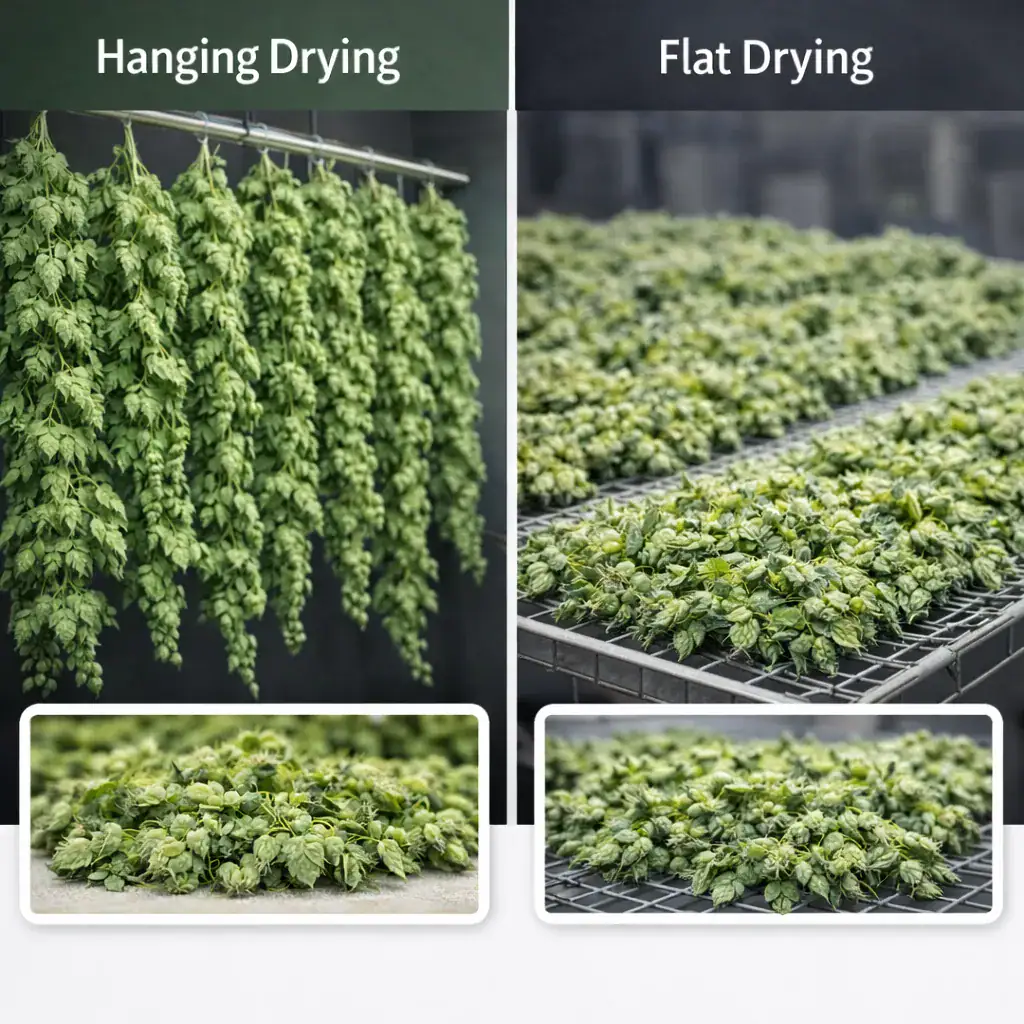
Drying orientation is often overlooked in flower buds post-harvest workflows, yet it plays a measurable role in moisture uniformity, terpene preservation, bud structure, and visual quality.This article breaks down why that happens—based on plant physiology, peer-reviewed research, and professional cultivation practice.
1. Why Drying Orientation Matters
Immediately after harvest, inflorescences continue to undergo internal moisture redistribution.
Drying orientation directly influences:
- Direction of moisture migration
- Air exposure symmetry
- Mechanical stress on trichomes
- Localized humidity pockets
- Final bud shape
These variables determine whether drying is uniform and controlled or uneven and aggressive.
2. Hanging Drying (Vertical Orientation)
Definition:
Whole plants or branches are suspended upside down, allowing buds to dry freely with minimal contact.
What Happens Physically
- Moisture exits gradually from stem → calyx → surface
- Air surrounds the entire bud
- Gravity prevents compression
Quality Impact
✔ More consistent internal moisture loss
✔ Better preservation of trichome heads
✔ Reduced terpene volatilization
✔ Natural, rounded bud structure
Industry Position:
Hanging drying is widely considered the benchmark method for premium flower.
3. Flat Drying (Horizontal Orientation)
Definition:
Buds or branches are placed on racks, trays, or mesh screens.
What Changes
- Buds contact a surface
- Airflow becomes asymmetrical
- Moisture can accumulate at contact points
Quality Trade-Offs
⚠ Risk of uneven drying
⚠ Flat spots or compressed calyxes
⚠ Increased handling (turning buds)
⚠ Greater terpene loss under high airflow
Research shows surface contact can slow evaporation locally, increasing moisture variability across a batch (Bernstein et al., 2019).
4. Terpene Retention: Orientation Matters
Terpenes are:
- Volatile
- Heat- and airflow-sensitive
- Easily lost during rapid dehydration
Hanging Drying Supports:
- Slower terpene evaporation
- Less physical disturbance
- More stable aroma development during curing
A 2024 MDPI study confirmed that slower drying protocols correlate with higher terpene preservation, independent of cultivar.
5. Structural & Visual Comparison
AttributeHanging DryingFlat DryingBud shapeNatural, fullRisk of flatteningMoisture uniformityHighVariableTrichome integrityBetter preservedHigher abrasion riskLabor inputModerateHigher (monitoring)Final presentationPremiumInconsistent
6. Mold Risk: A Common Misconception
Hanging drying does not increase mold risk when conditions are controlled.
Critical factors remain:
- RH: 55–60%
- Temperature: 16–20°C (60–68°F)
- Indirect airflow (no direct fan blast)
Flat drying can actually increase mold risk if airflow beneath buds is restricted.
7. Best Practices for Hanging Drying
For optimal results:
- Hang full branches, not individual buds
- Avoid overcrowding
- Maintain gentle air circulation
- Dry slowly before trimming
- Begin curing at ~10–12% internal moisture
These practices align with both academic research and commercial SOPs.
8. When Flat Drying Makes Sense
Flat drying may be appropriate when:
- Space is limited
- Using food-grade mesh racks
- Buds are rotated frequently
- Speed is prioritized over appearance
For top-shelf flower, it remains a compromise solution.
Final Takeaway
Drying orientation is a quality-defining variable, not a minor detail.
Current evidence shows:
- Hanging drying delivers superior aroma, structure, and consistency
- Flat drying increases variability and handling risk
- Premium flower benefits from slower, gravity-assisted drying
For growers focused on flavor, terpene expression, and visual excellence, hanging drying remains the preferred approach.
References
- Chandra, S., Lata, H., Khan, I. (2017). Flower Buds sativa L.—Botany and Biotechnology. Springer.
- Bernstein, N. et al. (2019). Impact of drying conditions on medical flower buds quality.
Frontiers in Plant Science.
https://www.frontiersin.org/articles/10.3389/fpls.2019.01136 - Brikenstein, N. et al. (2024). Optimization of post-harvest processing techniques for flower buds.
Plants, 13(6), 889.
https://doi.org/10.3390/plants13060889 - American Herbal Pharmacopoeia (2014). Plant Inflorescence Quality Control.
Related posts

Smart Curing Box VS. DIY Curing Setup, A Unstopable Trend.
Smart curing box VS. DIY curing setup? If you are a smart curing box user who had been switched from traditional operation, you will pr...
Read article
5 Key Factors That Enhance Flavor in Curing
First and foremost, we want to emphasize one core truth: every plant carries a unique, natural flavor. It is a one-of-a-kind gift from ...
Read article
Three Common Mistakes and Drawbacks of Traditional Room Drying
Room drying is one of the most widely used post-harvest methods in processing. At first glance, drying an entire harvest in a controlle...
Read article