
Drying Conditions for Flowers: Flavor & Curing Risks
Key Takeaways
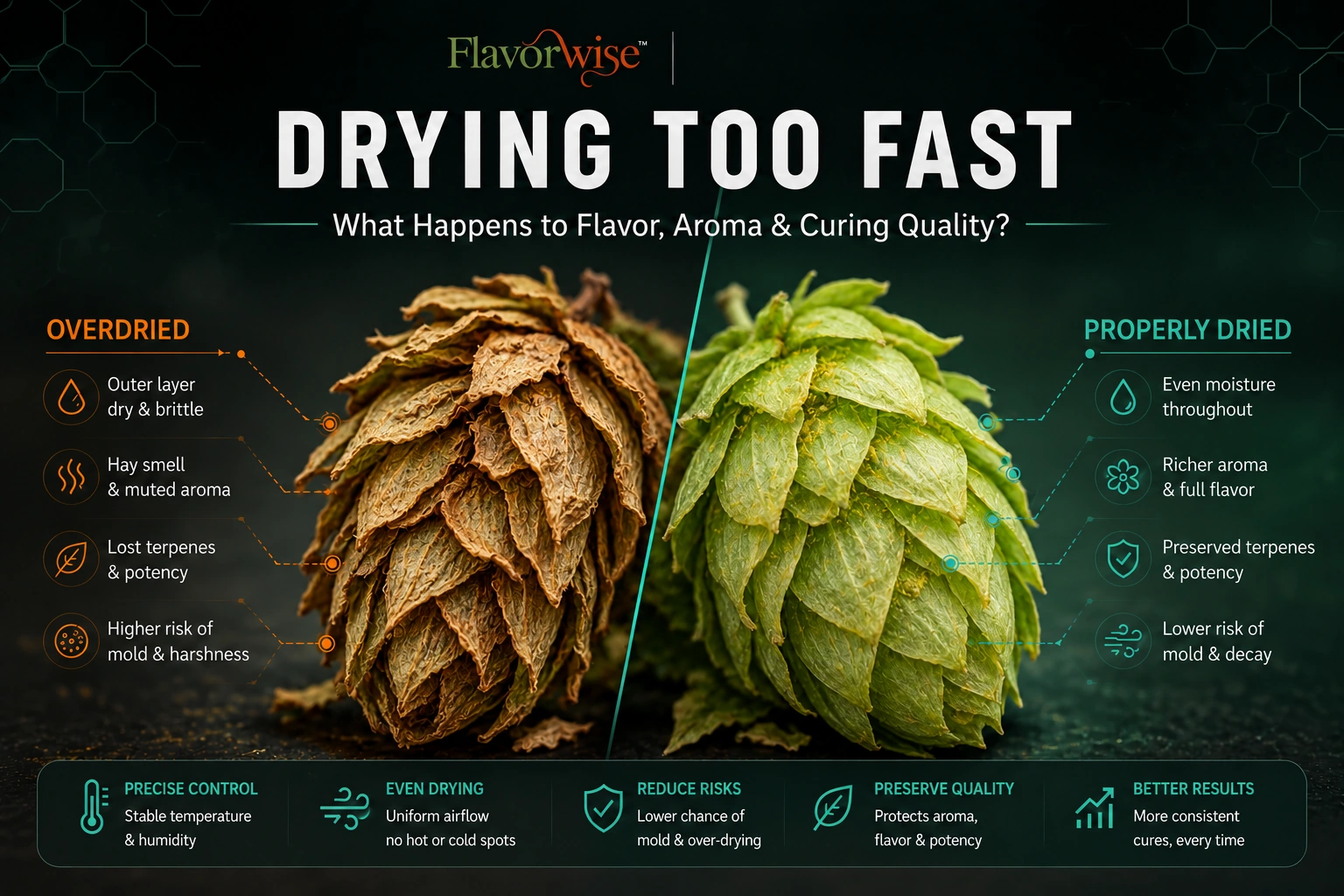
- Drying too fast can cause uneven moisture distribution, leaving the outside brittle while the inner core still holds moisture.
- A hay-like smell may happen when rapid drying interferes with chlorophyll breakdown and causes volatile aroma compounds to evaporate too quickly.
- Stable flower drying conditions usually depend on balanced temperature, humidity, and gentle airflow rather than speed alone.
- Curing may help with minor drying imbalances, but in most cases it cannot bring back volatile aroma compounds once they are lost.
- A controlled drying and curing cabinet helps reduce environmental guesswork and supports a more repeatable post-harvest workflow.
Flower Drying Too Fast: What Happens to Flavor, Aroma, and Curing Quality?
Have you ever experienced that disappointing moment right after harvest?
The day you cut down your plants, the space is full of rich, layered aroma. Everything feels promising. But after only three or four days of hanging, that aroma starts to fade. Instead of the profile you expected, you notice a hay-like or fresh-cut grass smell. The outer material feels dry, the stems seem close to snapping, and you start wondering whether the final quality has already been compromised.
This is one of the most common post-harvest concerns growers discuss online. Months of careful work can feel at risk during the final stage because drying is where aroma, texture, and curing quality are most vulnerable to environmental swings.
In many cases, the issue is not simply that drying happened “too quickly” on the calendar. The deeper problem is unstable drying conditions. Fast drying is not just a time problem. It is a stability problem.
Good post-harvest drying is about controlled moisture movement. The goal is not to force water out as quickly as possible. The goal is to create an environment where moisture can move gradually from the inside of the plant material toward the outside, while aroma compounds are protected as much as possible.
That is why stable flower drying conditions matter so much.
What Does “Drying Too Fast” Actually Mean?
When people talk about a fast dry, they often focus only on the number of days. For example, they may say the material dried in three days, four days, or under a week. But the timeline alone does not tell the full story.
The real issue is uneven moisture movement.
In an uncontrolled environment, moisture can evaporate from the surface too quickly. The outer layer becomes dry, crisp, and brittle while the inner core may still hold moisture. This creates a misleading “false dry” state. From the outside, the material feels ready. But internally, moisture has not had enough time to migrate outward in a balanced way.
This imbalance can affect the next stage. If the outside dries too hard while the inside remains moist, curing becomes less predictable. Moisture may redistribute unevenly in storage, and the final aroma may feel muted, grassy, or inconsistent.
A better drying process allows moisture to leave gradually. The outside should not be aggressively stripped before the inside has time to equalize. This is why temperature, humidity, and airflow need to work together.
Drying quality depends less on speed and more on environmental balance.
The Real Problem Is Unstable Drying Conditions
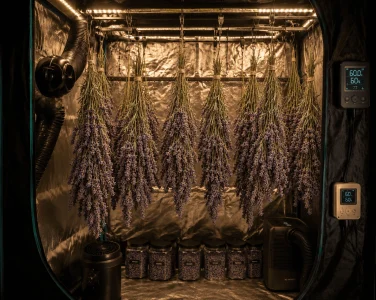
Stable flower drying conditions depend on balanced temperature, humidity, and gentle airflow rather than speed alone.
Most post-harvest quality issues do not come from one single mistake. They usually come from a combination of small environmental problems: room temperature rises during the day, humidity drops suddenly, airflow hits the material too directly, or the drying space reacts heavily to weather changes outside.
When growers talk about flower drying temp, it should not be separated from humidity and airflow. Temperature controls how quickly moisture wants to evaporate. Humidity controls how aggressively the surrounding air pulls moisture away. Airflow controls how quickly that moisture is removed from the surface.
If the drying temperature is too high, evaporation can accelerate. If humidity is too low, the air behaves like a sponge and pulls moisture out too aggressively. If airflow is too strong or pointed directly at the hanging material, the outer surface can dry before the internal moisture has time to move outward.
For flower drying temperature and humidity, 60°F / 60% RH is often used as a reference point, but it should not be treated as the only correct target. The real goal is stable temperature, balanced humidity, and gentle airflow.
The right humidity for drying flower depends on the room, harvest volume, airflow pattern, and how stable the environment remains over time. A number on a sensor is useful, but in real-world use, consistency matters more than chasing a perfect figure.
Some growers also search for the ideal vpd for drying flower. VPD can be helpful as a reference for understanding drying pressure, but it should not be treated as a rigid rule. For most post-harvest workflows, the practical goal is to avoid major swings in temperature, humidity, and airflow.
In simple terms, the environment should not push the material too hard. A stable microclimate gives drying a better chance to happen evenly.
Why Fast Drying Can Lead to Hay Smell or Muted Aroma
One of the most frustrating signs of a fast dry is the sudden appearance of hay-like or grassy aroma.
Freshly harvested plant material naturally contains chlorophyll. During a slower, more stable drying process, chlorophyll gradually breaks down and off-gasses. This helps the sharper green notes fade while the underlying aroma profile becomes clearer.
When drying moves too fast, that process may be disrupted. Moisture transport can slow down or stop before chlorophyll breakdown has progressed enough. The material dehydrates too quickly, and grassy notes may remain more noticeable in the final result.
At the same time, volatile aroma compounds are at risk.
Terpenes and other volatile aroma compounds help create the distinct sensory profile of each harvest. Many of these compounds are sensitive to heat, aggressive airflow, and overly dry environments. If the drying room gets too warm or the material loses moisture too quickly, delicate aroma compounds may evaporate before the curing stage has a chance to stabilize the final profile.
This is why a fast dry can leave the final material smelling flat, muted, or less expressive than expected.
It is not always one dramatic failure. From experience, it is usually a series of small environmental pushes: a room that gets too warm in the afternoon, a fan that hits the hanging material too directly, humidity that drops too low overnight, or a drying area that is too exposed to outside climate changes.
Over several days, those small swings can add up.
Can Curing Fix Material That Dried Too Fast?
This is one of the most common questions growers ask when they notice a hay-like smell or overly crisp outer texture: can curing fix it?
The honest answer is: sometimes, but not always.
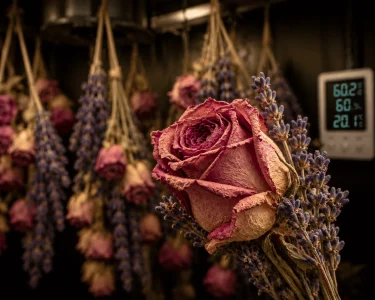
If the material experienced only a minor external flash dry, meaning the outside feels crispy but the inner core still holds some moisture, curing may help. Once placed into a controlled storage environment, internal moisture can slowly redistribute toward the outer layers. This can soften the texture and allow some remaining post-harvest processes to continue.
In that case, aroma may improve over time. The grassy notes may reduce, and the final profile may become more balanced.
However, if the material is fully overdried throughout, curing has limits. If there is not enough remaining internal moisture, the biological and chemical processes involved in curing can slow dramatically or stop. Once delicate volatile aroma compounds have evaporated into the room, curing cannot bring them back.
Curing helps preserve and refine post-harvest quality. It cannot fully recover what has already been lost through overly aggressive drying.
That is why the drying stage matters so much. Curing works best when drying has created the right foundation.
Why Fast Drying Is the Wrong Goal
It is understandable to want the final result quickly. After months of cultivation, waiting through the post-harvest stage can feel difficult. This impatience leads some beginners to search for phrases like fast dry flower, how do you dry flower fast, or fastest way to dry flower.
But fast is not the goal. Controlled drying is the goal.
Rapid drying methods may remove water quickly, but they can also increase the risk of uneven moisture distribution, hay-like aroma, muted sensory profile, and harsher final quality. A fast result is not the same as a good result.
Quality-focused post-harvest workflows focus on stability instead of speed. The aim is to manage moisture movement gently, protect volatile aroma compounds, and support a smoother transition into curing.
In premium processing, speed often works against consistency. The more aggressively moisture is removed, the harder it becomes to preserve the qualities developed before harvest.
A stable drying period usually gives the material a better chance to retain aroma, reduce harsh notes, and cure more evenly.
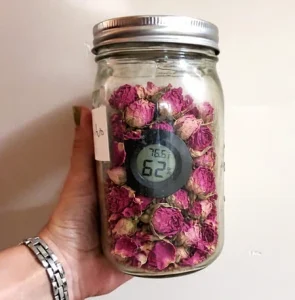
What Stable Environmental and Storage Conditions Change
When you shift the goal from speed to stability, the entire post-harvest process becomes more predictable.
Stable environmental conditions allow moisture to leave more gradually. This reduces the risk of the outside becoming brittle while the inside remains too moist. It also helps protect delicate volatile aroma compounds from heat, sudden dryness, and direct airflow.
A classic “low and slow” approach is often discussed because it gives the material more time to dry evenly. Again, 60°F / 60% RH is a common reference point, but it is not the only correct target. The real goal is to maintain steady temperature, balanced humidity, and gentle airflow for your specific room, volume, and workflow.
Consistent cool temperatures can help reduce aroma loss. Balanced humidity helps prevent both overdrying and overly damp conditions. Gentle airflow helps move moisture away from the space without stripping the surface too aggressively.
Storage conditions also matter after drying. If the environment becomes too dry, quality may continue to degrade. If it becomes too humid or unstable, curing becomes harder to control. A stable storage phase helps maintain the gains made during drying and curing.
This is why post-harvest microclimate control is becoming more important for growers who want repeatable results.
When a Controlled Drying and Curing Cabinet Makes Sense
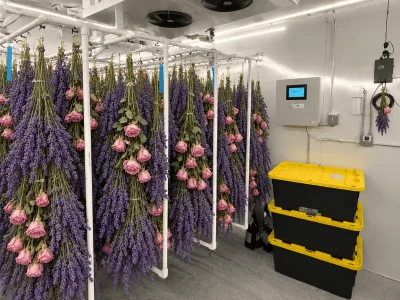
Many growers start with improvised drying spaces: a spare room, tent, closet, garage, or basement. These spaces can work, but in most cases they are difficult to control.
Room temperature changes throughout the day. Humidity shifts with weather. Air conditioners, heaters, dehumidifiers, and humidifiers may cycle on and off. Fans may create uneven airflow. The drying environment becomes something you constantly monitor and adjust.
For small-batch and quality-focused operators, that uncertainty can become stressful.
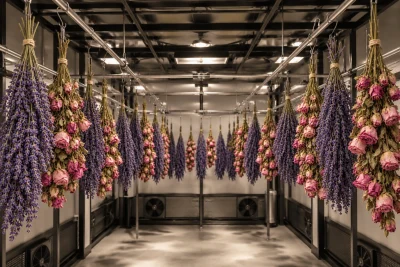
A controlled drying and curing cabinet helps reduce environmental guesswork by supporting stable temperature, balanced humidity, gentle airflow, and a more repeatable post-harvest workflow.
Instead of reacting to every room change, a dedicated post-harvest system is designed to create a more consistent microclimate around the material. This can help reduce the risk of rapid drying, uneven moisture movement, and batch-to-batch inconsistency.
Whether you use a precision drying and curing system or a standalone drying and curing machine, the main benefit is improved control. The system does not replace grower judgment or traditional craftsmanship. It supports the environment around the process so the final outcome becomes more consistent.
For growers working in unpredictable rooms, changing seasons, or limited spaces, a controlled cabinet can make the post-harvest phase easier to manage.
How to Think About Flower Drying Conditions More Practically
Instead of asking only, “How many days should drying take?” it is better to ask a more practical set of questions:
- Is the temperature staying stable during the full drying period?
- Is humidity balanced, or does it swing sharply during the day?
- Is airflow indirect and gentle, or is it hitting the material too directly?
- Does the outside feel dry much faster than the inside?
- Is the aroma becoming clearer, or turning grassy and flat?
- Are storage conditions stable enough to support curing after drying?
These questions help shift the process away from guessing and toward observation.
The goal is not to chase one perfect number. The goal is to keep the drying environment steady enough that moisture leaves gradually and the aroma profile has a better chance of being preserved.
This is the core idea behind post-harvest microclimate control.

FAQ
Q1: What happens if drying moves too fast?
Drying too quickly can cause the outer layers to become brittle while the inner core still holds moisture. It may also interfere with chlorophyll breakdown and increase the risk of hay-like smell, muted aroma, and harsher final quality.
Q2: Can curing fix a hay smell if drying was too fast?
Sometimes. If the material still has enough internal moisture, curing may allow moisture to redistribute and help the aroma improve over time. But if the material is completely overdried, curing cannot bring back volatile aroma compounds that have already evaporated.
Q3: Why does freshly harvested material smell like grass?
Freshly harvested plant material contains chlorophyll, which naturally creates grassy notes in the early drying stage. A stable drying process gives chlorophyll more time to break down, helping the underlying sensory profile become clearer.
Q4: Is the 60/60 rule the only way to dry properly?
No. 60°F / 60% RH is a common reference point, but it is not the only correct target. The real goal is stable temperature, humidity, and gentle airflow based on your environment, harvest volume, and workflow.
Q5: What is the ideal vpd for drying flower?
Some growers use VPD as a reference to understand drying pressure. However, for most post-harvest workflows, VPD should be treated as a guide rather than a strict rule. Avoiding major swings in temperature, humidity, and airflow is usually more practical.
Q6: What is the best humidity for drying flower?
The best humidity for drying flower depends on room stability, harvest volume, airflow, and storage goals. Instead of focusing only on one fixed number, growers should aim for a balanced environment that avoids sudden drops or spikes.
Q7: How does a post-harvest microclimate system improve stability?
A dedicated post-harvest microclimate control system uses sensors and environmental control to help reduce sudden changes in temperature, humidity, and airflow. This supports a more balanced drying process and a more repeatable workflow.
Final Thoughts
The harvest window is the worst time to lose control of your environment. Fast drying may seem convenient, but it often creates more risk than benefit.
Stable flower drying conditions help protect aroma, support smoother moisture movement, and create a stronger foundation for curing. Temperature, humidity, airflow, and storage should work together as one system, not as separate details.
Flavorwise is not a replacement for traditional craftsmanship. It is a way to make drying, curing, and storage environments more stable, controlled, and repeatable.
CTA
See the 200L Flower Drying & Curing Cabinet
Explore Controlled Post-Harvest Microclimate
Get Price / Book a Call
About the Author
Flavorwise Post-Harvest Research Team
The Flavorwise Post-Harvest Research Team studies post-harvest preservation, microclimate control, and plant quality stability. Through testing, precision engineering, and controlled-environment research, the team provides commercial and small-batch growers with practical insights to reduce environmental guesswork and support more repeatable post-harvest outcomes.

Related posts
Slower Isn’t Always Better: What Really Matters When Drying Flowers
Flower drying is often reduced to one simple rule: hold the room at roughly 60°F and 60% relative humidity, then wait 10 to 14 days. T...
Read article
Los Angeles Dispensary Deals: Cheap Flower vs Proper Post-Harvest Quality
Los Angeles dispensary deals can make premium-looking flower feel like an easy bargain. A lower price, though, does not tell you whethe...
Read article
Denver industry event: What Serious Growers Can Learn From Winning Flower
The Denver industry event was never decided by genetics or THC percentage alone. A winning entry still had to impress judges through it...
Read article